Catalina Island Diving: Casino Point and Beyond
Catalina Island diving is the easiest way to see a healthy California kelp forest without a long boat ride. The island sits about 22 miles off the Southern California coast, the water is usually clearer and a little warmer than on the mainland, and in Avalon you can walk down a set of stairs straight into a protected dive park.
Getting to Avalon
Passenger ferries run to Avalon from several Southern California harbors, including San Pedro, Long Beach, Dana Point and Newport Beach. The crossing takes roughly an hour, depending on the port and the boat. Most ferries allow dive gear and tanks, but each operator has its own rules for scuba cylinders and luggage, so check before you pack. Many divers travel light and rent tanks and weights in Avalon instead.
Avalon is a small town and most visitors get around on foot or by golf cart, so pick a place to stay within walking distance of the water. Our California dive accommodations guide covers what to look for in a dive-friendly room, from gear rinse space to early check-out times.
The Casino Point dive park
Casino Point, next to the round Casino building at the north end of Avalon Bay, is one of the best-known shore dives in California. Entry is down concrete steps built into the breakwater, so there is no surf entry and no long walk with tanks. The park is marked by a line of buoys, and inside it you are diving in the Casino Point State Marine Conservation Area, where all marine life is protected and nothing may be taken.
The bottom drops off quickly. Shallow rocky reef near the steps gives way to sand and kelp, and the park slopes past 60 feet within a short swim. That makes it a good site for new divers who want to stay shallow and for experienced divers who want a deeper second dive from the same entry.
Tips for diving Casino Point
- Arrive early. The steps and the area above them get busy with classes on weekends and in summer.
- Stay inside the buoys. Boats run just outside the park, and anchoring is not allowed inside it.
- Watch the steps. They can be slippery with algae. Put fins on in the water, holding the rail.
- Carry a surface marker if you plan to surface away from the steps.
What you will see in the kelp
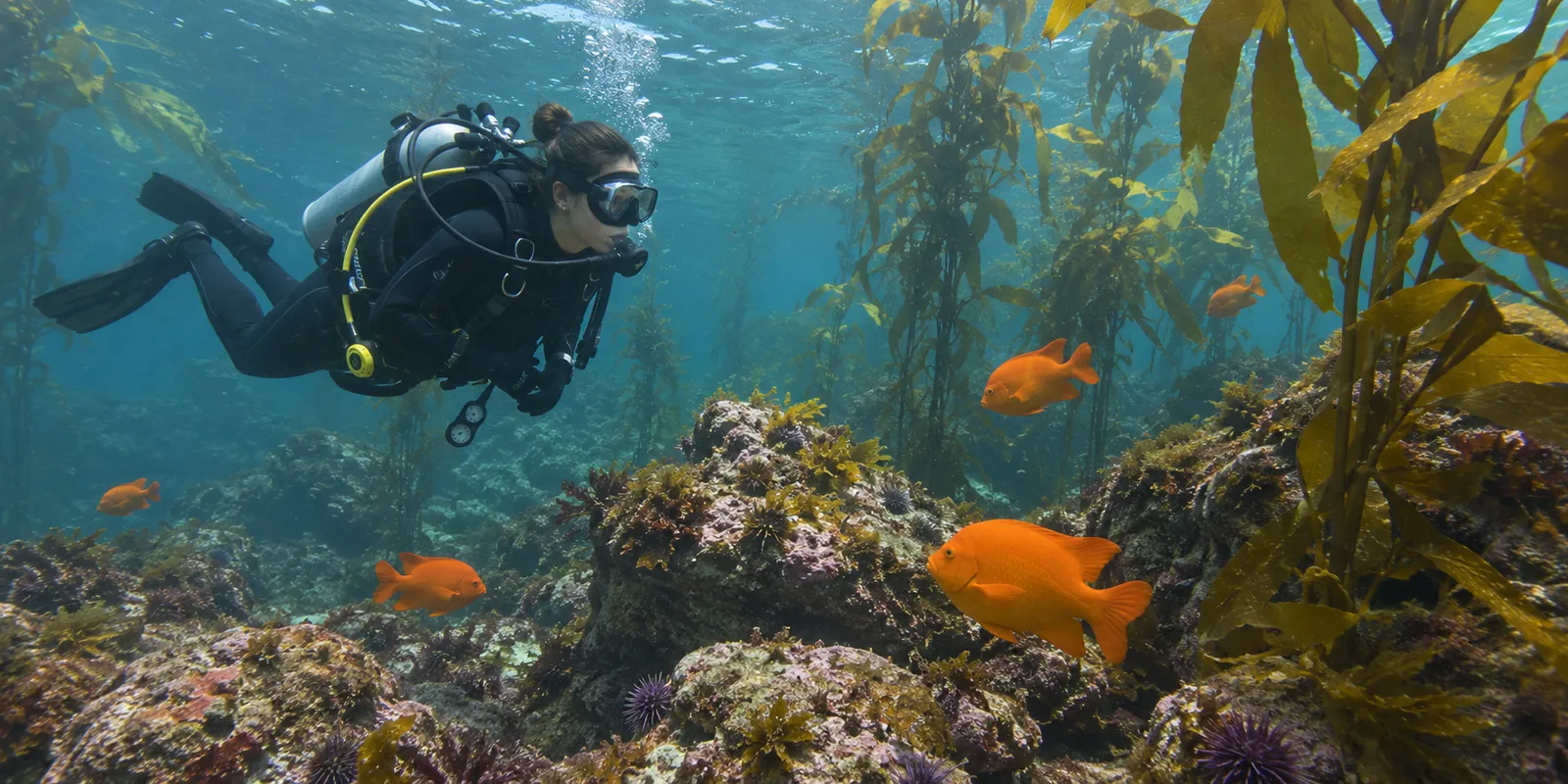
Giant kelp grows from the rocky bottom toward the surface and forms a forest that sways with the swell. Bright orange garibaldi, California's state marine fish, guard their patches of reef and will often come right up to your mask. Look for sheephead, kelp bass, opaleye and halfmoon in the canopy, and moray eels, lobsters and octopus in the cracks of the reef. Bat rays and horn sharks rest on the sand at the edges of the kelp.
Because the park is protected, the fish are used to divers and the reef is a good place to practice underwater photography.
Boat dives around the island
Most of Catalina's coastline is only reachable by boat. Dive boats run day trips from mainland harbors and from Avalon itself, visiting pinnacles, kelp beds and walls along the front (the side facing the mainland) and, when conditions allow, the more exposed back side of the island. The back side is often wilder and less dived, with bigger swells and more open-ocean visitors.
A local California dive shop can book boat dives, rent cold-water gear and tell you which sites are diving well that week.
When to go
Catalina can be dived all year. Late summer and early fall usually bring the warmest water, often in the upper 60s to low 70s Fahrenheit at the surface, and the best visibility. Winter water is cooler, in the high 50s to low 60s, but the island is quieter. See our California water temperature guide for a month-by-month view and what suit to wear.
Plan the rest of the trip
Combine a weekend in Avalon with other Southern California dives using our California dive travel guide, and if you want more islands, read our Channel Islands diving guide next.